How to Grow Mint Without Letting It Take Over
Mint is easy to grow and hard to stop. Here is how to give spearmint the moist soil it likes while keeping its runners inside a pot or barrier.
Almost every gardener who has grown mint has a story about it turning up three feet from where it was planted. The warnings are fair, but they should not put you off. Learning how to grow mint is mostly learning how to give it a boundary, and once that is done it is one of the least demanding herbs you can own.
This guide uses spearmint (Mentha spicata) as the example. Peppermint and most other garden mints behave in much the same way, so the same approach works for them.
What kind of plant mint is
Spearmint is a vigorous perennial. It dies back in cold weather and returns from its roots in spring, and it is listed for USDA zones 4 to 9. Treat that range as a rough guide instead of a promise, since a wet winter or an exposed pot can change the outcome. You can read more in the NC State Extension profile for spearmint.
Two habits explain its reputation:
- It spreads by rhizomes. These are underground stems that travel sideways through the soil and send up new shoots along the way.
- Its stems root where they touch the ground. A long stem that flops onto bare soil can anchor itself at a node and start a new plant.
Neither habit is a problem in a place where the plant has nowhere to go. Both are a problem in an open bed.
Where mint grows best
Mint thrives in moist, well-drained soil in full sun, meaning about six or more hours of direct sun, and it tolerates part shade. In a hot, bright spot the soil dries faster, so part shade in the afternoon can make the plant easier to keep going through summer.
Moisture matters more for mint than for most kitchen herbs. Thyme and rosemary prefer to dry out; mint does poorly in dry soil and shows it with limp stems and crisp leaf edges. Moist is not the same as waterlogged, though. Water should still drain through instead of pooling around the roots.
Contain it before you plant it
Containment is the main job, and it is far easier to set up on planting day than to add later. You have three workable options.
A pot of its own
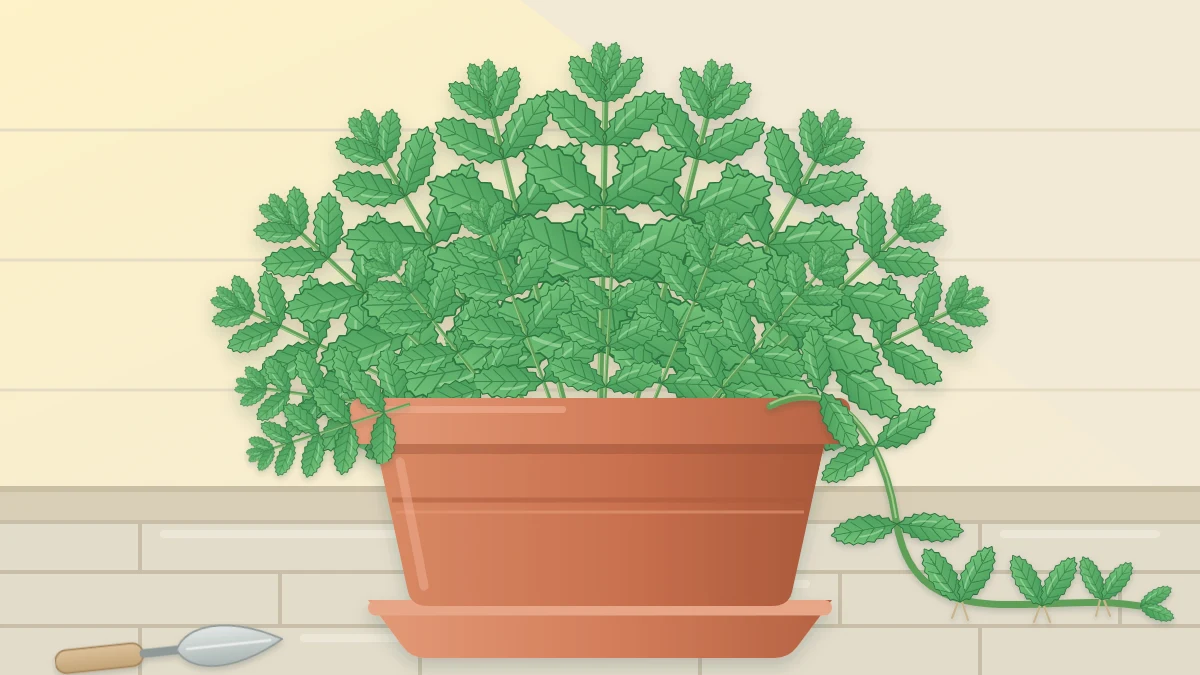
This is the simplest answer for most people. Give mint a wide container to itself, filled with potting mix, with drainage holes in the base. A wide pot suits it better than a tall narrow one because the rhizomes run outward just under the surface. The guide to growing herbs in containers covers pot size, drainage and potting mix in more detail.
A container on a hard surface
Set the pot on paving, a deck or a step instead of on bare soil. Roots and runners can leave through drainage holes or over the rim, and a hard surface gives them nothing to root into.
A soil barrier
If you want mint in the ground, surround it with a solid barrier sunk into the soil, with the top edge standing a little above the surface so rhizomes cannot simply cross over it. A barrier slows mint down. It does not make it stay put without help, which is why the edge checks below still apply.
Good to know
Do not plant mint in a mixed bed with slower herbs such as thyme, sage or chives. It will grow through and over its neighbors, and untangling mint rhizomes from another plant’s root ball is slow work.
Buy a plant and choose it by smell
Start with a starter plant instead of seed. Mints differ a great deal in scent and flavor, and seedlings do not reliably match what the packet describes. A plant lets you know exactly what you are getting.
At the nursery, rub a leaf gently between your fingers and smell it. Choose the plant whose scent you like best, since that is the one you will be cutting for drinks, salads and desserts. Look for firm stems, leaves without spots, and fresh growth at the tips.
Planting and watering
Plant in spring after your last frost, or any time during the growing season when you can keep the soil moist while the plant settles in. Set the root ball at the same depth it sat in its nursery pot, firm the mix around it, and water it in well.
After that, check the soil with a finger before you water. If the top inch (2.5 cm) feels dry, water thoroughly until it runs from the drainage holes. How often that happens depends on pot size, heat, wind and sun, so let the soil tell you instead of the calendar. A mint in a small pot in a heat wave might need water daily, while the same plant in cool, cloudy weather can go much longer.
Mint in fresh potting mix needs little feeding. If growth slows and leaves pale in a pot that has held the same mix for a long time, choose a fertilizer labeled for edible plants and follow the label rate.
Cut it often, and shear after flowering
Mint rewards regular cutting. Each time you snip a stem just above a leaf pair, the plant branches from that point and gives you two new shoots. Frequent cutting keeps the plant dense and the leaves young.
Left alone, stems grow tall, flower and turn coarse. When that happens, shear the whole plant back by cutting the stems down to a few leaf pairs above the soil. Fresh growth usually follows within a few weeks if the soil stays moist. For the reasoning behind where to cut, see the guide on how to prune herbs.
A big shearing leaves you with more mint than you can use fresh. That is a good moment to dry the extra stems for later.
Check the edges
Make a habit of looking around the plant whenever you harvest. You are checking for three things:
- Runners creeping over the rim of the pot or the top of the barrier.
- Roots or pale shoots coming out of the drainage holes.
- Long stems lying on soil or in a neighboring pot, where they can root.
Cut off anything that is escaping and pull up any piece that has already rooted. Small sections of rhizome can regrow, so lift them out whole instead of snapping them off at the surface.
Tip
When a potted mint becomes crowded and growth thins in the middle, tip it out, cut the root mass into sections, and replant one healthy piece in fresh potting mix. The plant often looks better within one season.
Frequently asked questions
Can I plant mint in the ground?
You can, but give it a boundary first. A solid barrier sunk into the soil, with its top edge standing slightly above the surface, slows the rhizomes down. Check the edge regularly and pull out anything that crosses it. For most gardeners a container on a hard surface is less work.
Why is my potted mint thin in the middle?
One common possibility is crowding. Mint fills a pot with rhizomes over time, and the center can thin out while growth continues at the rim. Tip the plant out and look. If the pot is packed with roots, cut the mass into sections and replant one healthy piece in fresh potting mix.
Should I let mint flower?
It does no harm, and pollinating insects visit the flowers. The leaves tend to become coarser as stems flower, though, so if you grow mint mainly for cutting, shear the stems back after flowering, or earlier, to push a fresh flush of young leafy growth.