Growing Herbs in Containers: Pots, Mix and Placement
A practical guide to outdoor herb pots: choosing the right size and material, filling them with potting mix, and placing them for sun and easy care.
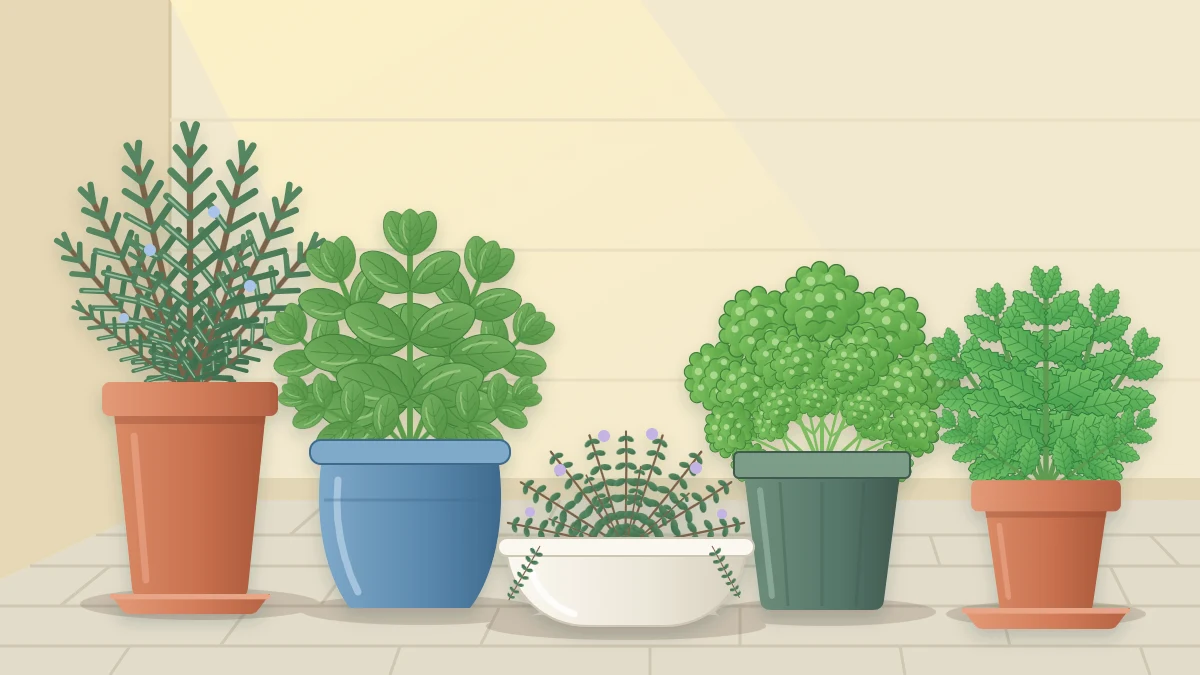
You do not need a garden bed to have fresh herbs outside the door. A sunny patio, a balcony or a set of front steps is enough, and growing herbs in containers has real advantages: you choose the soil, you can move a pot to follow the sun, and the plants sit close to where you cook.
Pots also ask for a little more attention than open ground. Three choices decide most of how well they do: the pot, what you fill it with, and where you set it.
Start with drainage
A drainage hole is essential. Without one, water collects at the bottom of the pot, the potting mix stays soggy and roots sit in water with no air. Most herbs decline quickly in those conditions, and thyme and rosemary are among the first to suffer.
If a pot you love has no hole, either drill one or use it as an outer sleeve around a plain pot that drains, and tip out any water that gathers inside. Outdoors, raise pots slightly on feet or a few flat stones so the hole cannot seal against a solid surface.
How big should the pot be?
Bigger pots hold moisture longer and need less frequent attention. A small pot looks neat on a step, but it has little mix to store water, heats up fast in the sun and can dry out in hours on a hot, breezy day.
As a starting point, a pot about 8 to 10 in (20 to 25 cm) wide suits a single small herb such as thyme, chives, parsley or one basil plant. Choose something wider and deeper for rosemary, which grows into a woody shrub, or for several herbs sharing one container.
These are rough guides, not rules. A plant that wilts quickly between waterings, or has roots circling the surface or growing out of the drainage hole, is telling you it wants a larger pot. University of Maryland Extension has more on pot sizes and materials in its guide to growing vegetables in containers.
Pot materials and what they suit
The material changes how fast a pot dries, so match it to the herb.
| Material | How it handles water | Good match |
|---|---|---|
| Unglazed terracotta | Porous, dries faster | Rosemary, thyme |
| Glazed ceramic | Holds water longer | Basil, parsley, mint |
| Plastic | Holds water longer, light to move | Basil, parsley, mint |
Unglazed terracotta lets moisture pass through its walls, which suits herbs that like to dry a little between waterings. Plastic and glazed pots keep the mix moist for longer, which helps leafy herbs that dislike drying out.
Weight matters too. A heavy pot stays upright in wind, while a light one is easier to shift into shelter.
Fill pots with potting mix, not garden soil
Use a potting mix made for containers. It is blended to stay loose and airy in the confined space of a pot while still holding moisture.
Never fill pots with soil dug from the garden. In a container it packs down, drains poorly and squeezes out the air that roots need, even if the same soil grows fine plants in the ground. It can also bring weed seeds along.
- Moisten dry mix before you fill, so it takes up water evenly.
- Fill to a couple of inches (about 5 cm) below the rim, leaving room to water without overflow.
- Skip the layer of gravel or broken pots in the bottom. It takes up root space and does not improve drainage.
When you are ready to plant several herbs together, the step-by-step guide to planting a mixed herb pot shows which ones share well and how to arrange them.
Where to put the pots
Place pots where they get the sun the herbs need. Most culinary herbs want full sun, which means about six or more hours of direct sun a day. Parsley, chives, cilantro and mint manage in part shade, and in hot climates they often appreciate some shelter from the fiercest afternoon sun.
Convenience counts as much as light. Set the pots where you will pass with a watering can, close to a tap if you can, and near the kitchen door. Herbs you walk past every day get checked, watered and picked. Herbs at the far end of the yard get forgotten.
Tip
Group pots together instead of dotting them around. They shade each other’s sides, lose moisture more slowly and take one trip to water.
Water and feeding in pots
Containers dry out much faster than beds, especially in heat and wind. Roots cannot reach beyond the pot for moisture, so the plant depends entirely on you.
Check moisture often by pushing a finger into the mix. How quickly a pot dries depends on its size and material, the weather and how large the plant has grown, so the same pot can need very different care in spring and in a heat wave. The guide to watering herbs explains how to read the soil and water thoroughly.
Nutrients also wash out through the drainage hole with every watering, and the mix has only so much to give. Feed lightly through the growing season with a product labeled for edible plants, following the label rate. Too much fertilizer pushes soft growth with weaker flavor. For the basics, see how to fertilize herbs.
Which herbs do well in pots
Nearly every common culinary herb will grow in a container if the pot is large enough. Basil, parsley, chives, thyme, oregano and sage are all easy choices, and rosemary does well in a deep pot of its own.
Mint is the one herb that belongs in a pot even when you have a garden. It spreads by runners and can take over a bed, so a container is the simplest way to keep it in bounds. The mint growing guide covers how to manage it.
Cold weather and container roots
In the ground, the surrounding soil buffers roots against sudden changes in temperature. A pot has no such protection, so frost and winter cold reach roots in containers sooner than in a bed.
Good to know
A perennial herb that comes through winter in your garden bed may not survive the same winter in a pot. Before hard frost, move pots against a sheltered wall or into a protected spot, and never leave them standing in water.
Tender annuals such as basil end with the first frost wherever they grow, so enjoy them through the warm months and replant the following year.
Frequently asked questions
Can I reuse last year's potting mix for herbs?
Often yes, if the plants that grew in it were healthy. Tip it out, break up the clumps, remove old roots and blend in fresh potting mix or a little finished compost to restore its structure. Start with new mix if the old plants had disease or pest trouble, or if the mix has become dense and slow to drain.
Do herb pots need rocks in the bottom for drainage?
No. A layer of gravel or broken pots does not improve drainage and takes away space that roots could use. What matters is an open drainage hole and a loose potting mix. If you worry about mix washing out, cover the hole with a small piece of mesh.
Why do my potted herbs dry out so fast?
Several things can be at work. The pot may be small for the plant, the roots may have filled it, or the pot may be porous terracotta in a hot, windy position. Check for roots at the drainage hole. Moving up a pot size, grouping pots together or shifting them out of the wind usually slows the drying.