Annual vs Perennial Herbs: Which Ones Come Back?
Which kitchen herbs need replanting every year, which return on their own, where parsley and rosemary fit, and how to use life cycles and hardiness zones when you plan a bed.
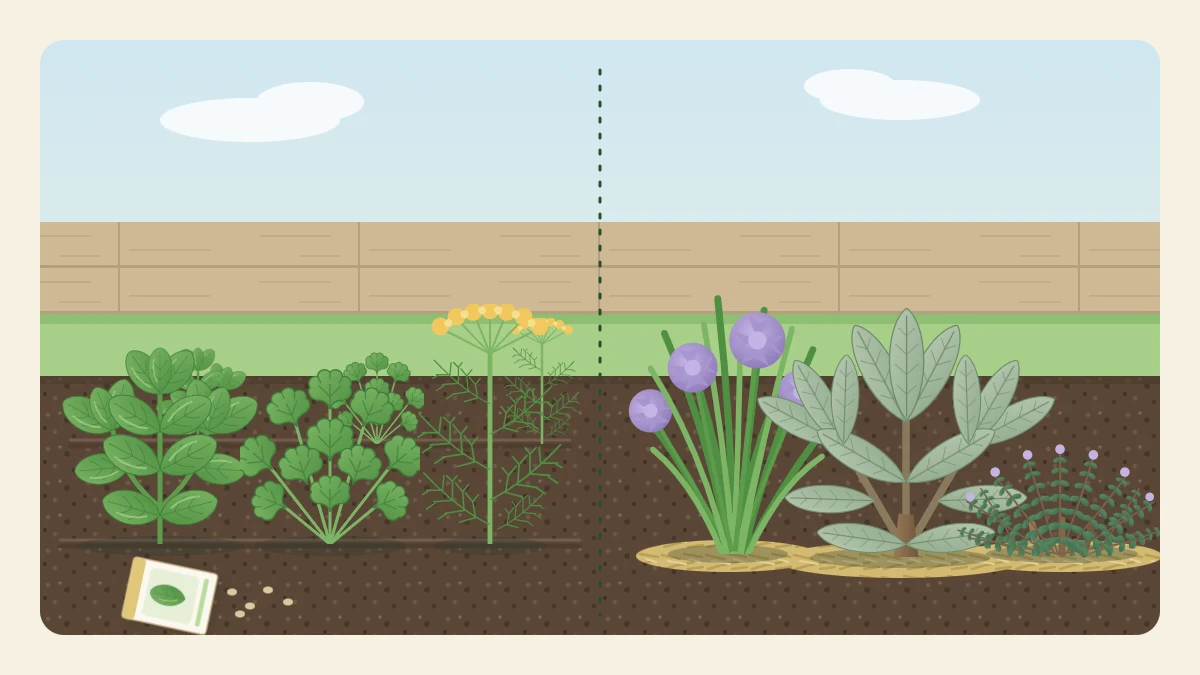
Some herbs are planted once and stay for years. Others are gone by the first hard frost and have to be started again in spring. Sorting out annual vs perennial herbs tells you which is which, and it shapes how you lay out the garden and what you buy each year.
There is also a third category, the biennial, and one popular herb whose answer depends on how cold your winters are. Here is how the common kitchen herbs sort out.
What the terms mean
- Annual: a plant that completes its whole life in one growing season. It sprouts, grows, flowers, sets seed and dies.
- Biennial: a plant that takes two seasons. It grows leaves the first year, then flowers, sets seed and dies the second.
- Perennial: a plant that lives for several years, regrowing from its roots or keeping its woody stems from one season to the next.
These words describe a plant’s natural life cycle. How a herb behaves in your garden also depends on your winters, which is where hardiness zones come in.
Annual herbs: replant each year
Cilantro and dill are cool-season annuals. They put on leaves in cool weather, then flower, set seed and die. Both self-seed, so if you leave a few seed heads to ripen and drop, new seedlings often appear nearby without any help. They are not the same plants coming back, but the effect in the bed is similar.
Basil is a different case. It is frost-tender and is grown as a warm-season annual in most of the US: planted after the last frost, harvested through the warm months and killed by the first frost of fall. See how to grow basil for getting the most from that one season.
Parsley, the biennial
Parsley makes a leafy clump in its first year. If it comes through winter, it sends up a flower stalk in its second year, sets seed and dies. Because the first-year leaves are the harvest, parsley is usually grown as an annual and replanted every spring.
Leaving one or two second-year plants to flower does no harm if you have the room. Just do not count on them for the kitchen.
Perennial herbs: plant once
Perennials are listed for a range of USDA hardiness zones. The ranges below come from the NC State Extension plant profiles.
- Chives are listed for USDA zones 4 to 8. The leaves die back in winter and the clump resprouts in spring.
- Mint (spearmint) is listed for zones 4 to 9. It spreads vigorously, so it is best kept in a container of its own.
- Oregano is listed for zones 4 to 8 and forms a bushy clump that widens over time.
- Common sage is listed for zones 4 to 8. It is a semi-woody plant that is often replaced after several years as it becomes sparse.
- Common thyme is listed for zones 5 to 9. It is a low, woody evergreen.
If you want one perennial to begin with, chives are a forgiving choice. The guide on how to grow chives covers planting, cutting and dividing the clump.
Rosemary: perennial where winters are mild
Rosemary is a woody evergreen listed for zones 8 to 10. Within that range it can live in the ground for years and grow into a shrub. In colder regions it is treated as an annual, or grown as a pot plant that is moved to shelter before hard cold arrives.
So the honest answer to “is rosemary a perennial?” is that the plant is, but your garden may not let it behave like one.
Herb life cycles at a glance
| Herb | Life cycle | Listed zones |
|---|---|---|
| Basil | Frost-tender; grown as a warm-season annual | Replant yearly |
| Cilantro | Cool-season annual; self-seeds | Resow yearly |
| Dill | Cool-season annual; self-seeds | Resow yearly |
| Parsley | Biennial, usually grown as an annual | Replant yearly |
| Chives | Perennial | 4 to 8 |
| Mint (spearmint) | Perennial | 4 to 9 |
| Oregano | Perennial | 4 to 8 |
| Common sage | Perennial | 4 to 8 |
| Common thyme | Perennial | 5 to 9 |
| Rosemary | Woody evergreen perennial | 8 to 10 |
Zones are a rough guide
Hardiness zones are based on average winter low temperatures, and you can look up your own on the USDA Plant Hardiness Zone Map. If your zone falls inside a herb’s listed range, the plant has a reasonable chance of coming through winter outdoors.
It is not a promise. An unusually harsh winter, an exposed windy corner or soil that stays wet through the cold months can finish a plant that is, on paper, well within its range. A sheltered spot beside a sunny wall can do the opposite and carry a borderline plant through.
Good to know
Read the plant label before you buy. Named varieties, especially those with purple, golden or variegated leaves, may be less cold-tolerant than the plain green form, and the label should give the range for that particular plant.
If you garden near the cold end of a herb’s range, a little protection goes a long way. The guide to overwintering herbs explains what to do in fall and how to handle pots.
What this means for planning
Knowing the life cycle of each herb changes where you put it.
- Give perennials a permanent spot. Chives, thyme, oregano and sage should go where they will not be dug up when you clear and replant the rest of the bed. Corners, edges and one dedicated end all work well.
- Use annuals to fill gaps. Basil, cilantro, dill and parsley can go between young perennials, in a separate block or in pots, and they move to a new position each year without any trouble.
- Expect to resow. Cilantro and dill finish quickly, so a few small sowings during the cool part of the season keep leaves coming longer than one large one.
- Budget accordingly. Perennials are bought once as plants. Annuals are an every-year purchase, though a packet of seed goes a long way.
Timing differs between the groups as well: hardy perennials can go in earlier than tender basil. The guide on when to plant herbs ties each group to your local frost dates.
Frequently asked questions
Which herbs come back every year?
Chives, mint, oregano, common sage and common thyme are perennials that can return each spring where winters fall within their listed USDA hardiness range. Rosemary is also a perennial, but it is listed only for mild-winter areas, so in colder regions it is grown in a pot or replanted.
Is basil an annual or a perennial?
In most of the US basil is grown as a warm-season annual. It is frost-tender, so it is planted after the last spring frost and dies with the first frost of fall. Plan to start new basil each year from seed or from starter plants.
Why does parsley flower in its second year?
Parsley is a biennial. It spends its first season producing leaves, then uses its second season to flower and set seed before dying. Since the leaves are what cooks want, most gardeners treat parsley as an annual and set out new plants each spring.